The 2030 FIFA World Cup in Spain, Portugal & Morocco is only about 46 moons away (depending on your own set of lunar circumstances) and it promises to be a real doozy. World Cup history is a tale resplendent with stories of triumph against the odds, childhood dreams coming true and unsung heroes becoming legends. As well as dumb idiot losers, wanker fuck-ups and teams that are just total bullshit.
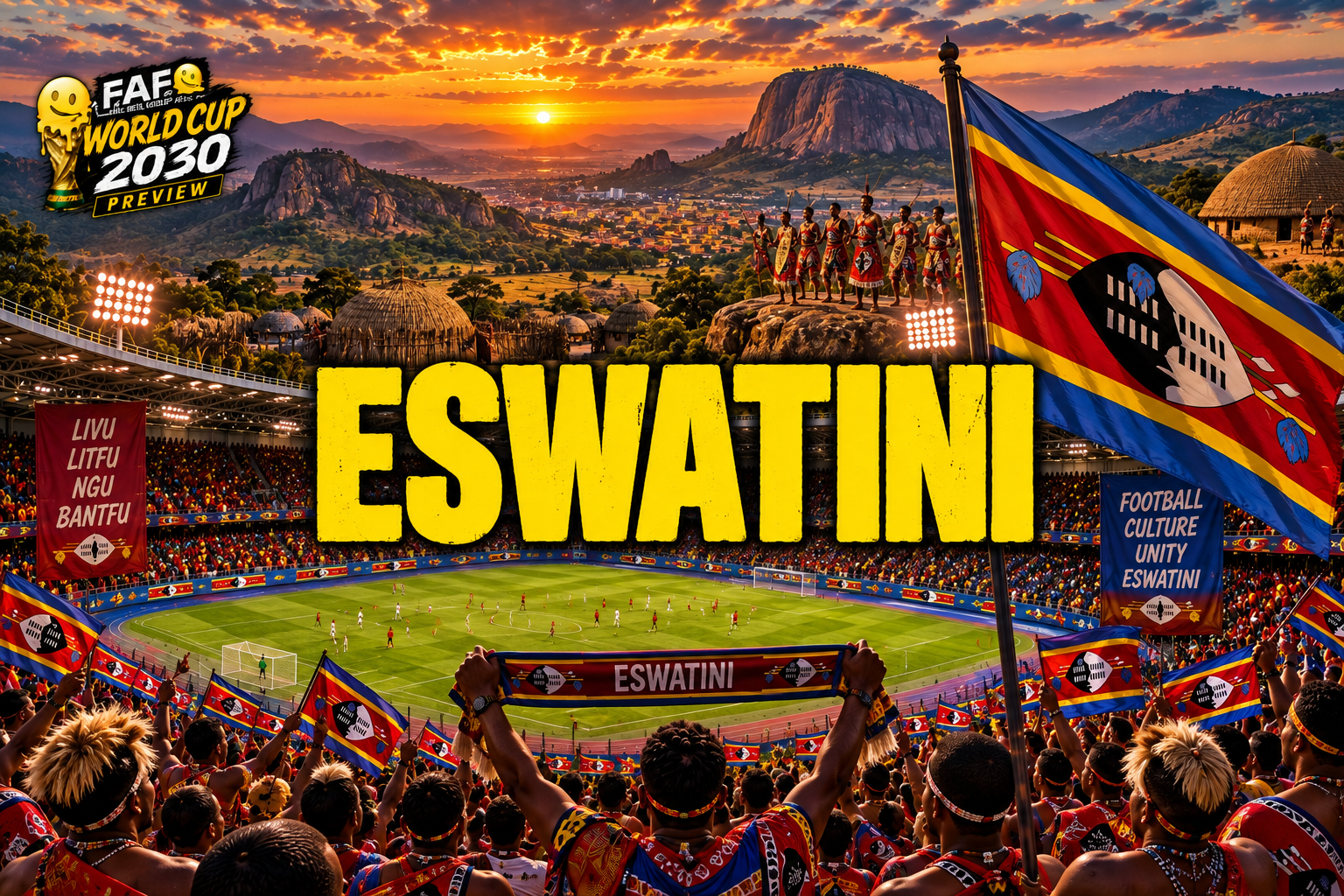
But how shall ye learn about these legends, losers and teams that are just total bullshit? Well look no further my wayward friend as I, along with the WHEEL OF NATIONS (There is only One Wheel, and FAFO is its Prophet), profile all 211 FIFA member associations eligible for World Cup qualification. Today, I take a look at Eswatini, which is yet to qualify for a World Cup.


ESWATINI
Yep, THAT Eswatini that lost to Djibouti in 2019

Nickname: Sihlangu Semnikati (King’s Shield)
FIFA Ranking: 164 (Sep 2026)
Qualified for World Cup Finals: Never
Best WC result: As Swaziland, they reached the second round of African qualifying for 2018, beat Djibouti 8–1 on aggregate, then held Nigeria 0–0 at home before losing the return leg 2–0; they never reached the final qualifying group.
FIFA World Cup 2026 result: Finished bottom of their six-team group with three points from ten games and no wins.
WATCH: 🇸🇿 ESWATINI – FULL WORKFLOW — WHEEL OF NATIONS – FAFO: World Cup 2030 Weekly Wheel of Nations – pt. XII – September 26, 2026:
Eswatini. Yep, Eswatini. The same Eswatini that blew it against Djibouti (Africa’s third lowest ranked team and a team ranked 195th and 36 places below it at the time in the FIFA rankings), in the playoff first round of African qualifying, in September 2019. The Eswatini that went away to Djibouti City and conceded two penalties and eventually fell to a shocking 2-1 loss. None other than that very same Eswatini that then came home for the return leg and couldn’t even breech the Djibouti defence once, were held goalless and consequently knocked out of World Cup qualifying on away goals.
Yup.
That Eswatini.
SIDENOTE:


But you may be asking yourself, ‘How did that happen’? How did they possibly lose to Djibouti? Well, 3 reasons:
1. Vultures

Eswatini is home to the world’s largest population of nesting vultures and any professional athlete will tell you that it’s tough to perform at your peak level when you are required to be in an exposed, unenclosed outdoor area for two hours with the ever looming threat of disembowelment by a flock of satanic shrieking trash birds. Despite dominating the tie and proving themselves to be superior in most areas of the park, the unrelenting fear of murder by avian evisceration may have proved too much for the Eswitanis to handle.
2. Not enough albinoes or epilepsy sufferers sacrificed

The blood of people with albinism or epilepsy is believed to bring good luck in Eswatini, but perhaps the team’s elimination from world cup contention is due to the simple fact that they did not properly prepare by slaughtering enough of these two groups of people. Had the team merely crossed their t’s and dotted their i’s and exterminated and dismembered a sufficient number of epilectic or albino heathens as part of traditional local witchcraft ceremonies, they might have been getting ready for the second round of African qualifying, not calculating how much cattle their daughter is worth or getting AIDS like the rest of the country.
3. Focused too much on preparing their daughters for Umhlanga

Umhlanga is an annual fertility festival where the king chooses 365 confirmed virgins to live with him and be part of his harem for the following year. Any top class athlete will tell you that if your mind is not focused on the game but instead on either competition for your spot in the team, pressure from the media or a customary annual reed-dancing festival where 25,000 unmarried girls parade themselves for a king already with 17 wives, you’re in big trouble.
One to watch: Highlights of Eswatini-Djibouti, World Cup Qualifiers, 10th September 2019 (not all the bad bits)
If you didn’t already sit back and enjoy the highlights above, you’d be best advised to avoid these disgusting “high”lights of both the first and second legs of Eswatini’s catastrophic tie against Djibouti in qualifying for the 2022 FIFA World Cup. But that doesn’t mean it was a total loss, because as you can see below, there still were a couple highlights for fans of Sihlangu Semnikati:


Last three World Cup campaigns
In 2018 they f; in 2022 they went out to Djibouti 2–1 on aggregate in round one; and in 2026 they finished bottom of their six-team group with three points from ten games and no wins.
2026: Finished bottom of their six-team group with three points from ten games and no wins
2022: Went out to Djibouti 2–1 on aggregate in round one
2018: Fell to Nigeria 2–0 on aggregate in round two
The Highpoint: Yeah, sure as shit not this
Never mind the epic music or mousification of commentator David something’s voice, the second leg vs Djibouti in 2022 World Cup qualifying was certainly not Eswatini’s finest moment
A sporting experience you’ve gotta go to that’s uniquely local and awesome (and doable): Mbabane Swallows vs Mbabane Highlanders
This is absolutely the one: the Mbabane Derby, Swallows against Highlanders, the country’s two historic football rivals. Local coverage calls it the biggest game in the Eswatini football calendar, with a rivalry stretching back decades; the 2026 meetings have been played at Mavuso Sports Centre and Somhlolo National Stadium.
Okay, but that’s enough about Djibouti. Get ya mind off Djibouti.
Because there’s been positive results since, then , most notably, Eswatini winning bronze at the 2021 COSAFA Cup, defeating then-100th ranked Mozambique on penalties. HECK YEAH, Eswatini!


One unique natural experience to see/visit/experience: climb Sibebe Rock

Sibebe Rock, just outside Mbabane: an enormous exposed granite dome with community-run walking tours across the rock and surrounding countryside. Eswatini’s tourism authority describes it as the world’s largest exposed granite dome and one of the country’s best walking destinations.
One town/city/neighbourhood the locals love: Lobamba

I’m taking Lobamba rather than Mbabane or tourist-heavy Ezulwini. It’s the country’s spiritual, cultural and traditional heart, sitting in the Ezulwini Valley and closely connected to Swati national ceremonies and institutions.
Food you’ve gotta have: sishwala with emasi

Sishwala — thick maize porridge — particularly served with emasi, fermented/soured milk. It’s basic home food rather than restaurant theatre, and that’s precisely why it passes our “what would you miss if you moved overseas?” test.
A drink you’ve gotta smash: buganu


This is a cracker: buganu, the seasonal fermented drink made from marula fruit. It isn’t merely something manufactured and sold as “traditional”; its preparation is central to Eswatini’s annual Marula Festival, with women collecting the fruit and preparing the brew during marula season.
The Wedding Banger – Eswatini’s unofficial anthem: “Tigi” — Sands
Tigi” by Sands (Sandziso Matsebula). I can’t substantiate “every Swati wedding plays it”, so I wouldn’t say that on air. But it passes the broader test: a huge siSwati-language Afro-soul/pop hit from one of the country’s biggest contemporary musicians, centred on love and widely recognised beyond Eswatini as well. Sands has even performed it at events specifically for married couples.
And wonderfully, Sands himself got married at House on Fire in Eswatini in 2021.

3 Legends
3 Legends
⚽ Sport — Tony Tsabedze: One of the defining figures of modern Eswatini football: longtime national-team player, successful professional in South Africa and Mbabane Swallows great, with more than 70 international appearances.
🎵 Music — Bholoja: Mbongiseni Ngubane, the singer-songwriter behind Swazi Soul — blending siSwati, traditional Swati influences, soul, jazz and blues while deliberately preserving the country’s language and musical heritage. He’s performed internationally and collaborated with artists including Hugh Masekela and Vusi Mahlasela.
📚 Culture — Sarah Mkhonza: Swati novelist, poet, journalist and academic whose writing explored women’s lives and Swazi society; she taught at the University of Swaziland before later working at universities in the United States.
🫠 FAFO Favourites
⚽ Sport — Sibusiso Matsenjwa: Eswatini’s outstanding modern sprinter, a three-time Olympian who repeatedly broke national records on the international stage and currently holds the country’s 200m record at 20.22. He’s a strong five-minute voice for the wonderfully simple question: what is it actually like representing a country of barely more than a million people at the Olympics? World Athletics
🎵 Music — Sands: Probably my first outreach attempt. He’s contemporary, performs in siSwati, took “Tigi” beyond Eswatini and can answer half our Wheel in one conversation: music, weddings, language, identity and what Swatis actually listen to. BlueTreeAudio
📚 Culture — Ntsika Kota: This is a very FAFO pick. He’s a Mbabane-born chemist and self-taught writer who became the first Swati to win the overall Commonwealth Short Story Prize, winning in 2022 with and the earth drank deep. Rather than asking a generic celebrity about Eswatini, you could ask a storyteller from the country what outsiders fundamentally don’t understand about it.
Learn the lingo & speak like a local!